Places
Bahawalpur
About this place
Bahawalpur is one of the most historically distinctive cities of southern Punjab and an important centre of Saraiki culture, heritage and regional history. Situated on the edge of the Cholistan Desert, the city developed as the capital of the former Bahawalpur State and became the centre of the powerful Abbasi dynasty that ruled the region for more than two centuries.
The city's identity is closely connected with the royal heritage of the former Bahawalpur State, the vast landscapes of Cholistan, the historic forts and caravan routes of the desert, the Sufi heritage of Uch Sharif, traditional crafts, agriculture, education and the Saraiki language.
Bahawalpur combines the atmosphere of a historic princely city with the character of a modern urban centre. Its palaces, mosques, forts, bazaars and cultural institutions preserve memories of the region's royal past, while the surrounding desert and agricultural landscapes connect the city with the wider cultural geography of southern Punjab.
GEOGRAPHY & LOCATION
Bahawalpur is located in southern Punjab, close to the Sutlej River and on the northern edge of the Cholistan Desert.
Bahawalpur District covers approximately 24,830 square kilometres and is one of the largest districts of Punjab by area.
According to the 2023 Census, Bahawalpur District had a population of approximately 4.28 million people.
The district borders India to the east, Rahim Yar Khan District to the south, Bahawalnagar District to the north and Lodhran and Muzaffargarh districts toward the west.
Its geographical position gives Bahawalpur a distinctive landscape where fertile agricultural plains gradually transition into the desert environment of Cholistan.
THE ORIGINS OF BAHAWALPUR
The modern city of Bahawalpur was established in the eighteenth century by Nawab Muhammad Bahawal Khan II of the Abbasi dynasty.
The city was named Bahawalpur in his honour.
The establishment of Bahawalpur marked the development of a new political and administrative centre in the region.
Over time, the city grew around the ruling family, administrative institutions, markets, religious buildings and residential areas.
THE ABBASI DYNASTY
Bahawalpur's history is closely associated with the Abbasi dynasty.
The Abbasi rulers established Bahawalpur State and gradually expanded their influence across a large area of southern Punjab and Cholistan.
The dynasty maintained its political authority through changing regional circumstances, including the decline of Mughal power, the rise of Sikh influence in Punjab and eventually British paramountcy.
The rulers invested in palaces, mosques, roads, irrigation systems, educational institutions and other public works.
Their legacy remains visible throughout Bahawalpur and the surrounding region.
BAHAWALPUR STATE
Bahawalpur State was one of the princely states of the Indian subcontinent.
The state covered a large territory and included important settlements, agricultural areas and desert regions.
The Abbasi rulers maintained their own administration and royal institutions while maintaining relationships with larger political powers.
During the British period, Bahawalpur retained its princely status under British paramountcy.
The state continued to have its own ruler, administrative structures and royal court until the political transformation that followed the creation of Pakistan in 1947.
BAHAWAL KHAN II
Nawab Muhammad Bahawal Khan II is traditionally associated with the foundation of the modern city of Bahawalpur.
His establishment of the city created a political centre that would eventually become the capital of Bahawalpur State.
The city continued to expand under his successors and developed into one of the most important centres of southern Punjab.
THE NAWABS OF BAHAWALPUR
The rulers of Bahawalpur are commonly known as the Nawabs of Bahawalpur.
Several generations of the Abbasi family ruled the state.
Among the best-known rulers was Nawab Sadiq Muhammad Khan V, the final ruling Nawab of Bahawalpur.
His reign witnessed major developments in education, infrastructure, architecture and public institutions.
Many of the buildings that define Bahawalpur's architectural identity were constructed or developed during the later period of the Bahawalpur State.
NAWAB SADIQ MUHAMMAD KHAN V
Nawab Sadiq Muhammad Khan V was the last ruler of Bahawalpur State.
He succeeded to the throne as a young ruler and remained in power until the integration of Bahawalpur into Pakistan.
His reign is particularly associated with education, architecture, public works and institutional development.
Several famous buildings and institutions in Bahawalpur are connected with his period.
His legacy remains visible in the city's palaces, educational institutions and public architecture.
BAHAWALPUR & PAKISTAN
The relationship between Bahawalpur State and Pakistan is an important part of the region's modern history.
Following the creation of Pakistan in August 1947, Bahawalpur acceded to Pakistan.
The state initially retained its internal administrative identity before being integrated into the wider provincial structure of Pakistan in 1955.
The former state eventually became part of West Pakistan and later Punjab after the provincial reorganization of Pakistan.
This transition marked the end of the Bahawalpur State as a separate princely administration.
NOOR MAHAL
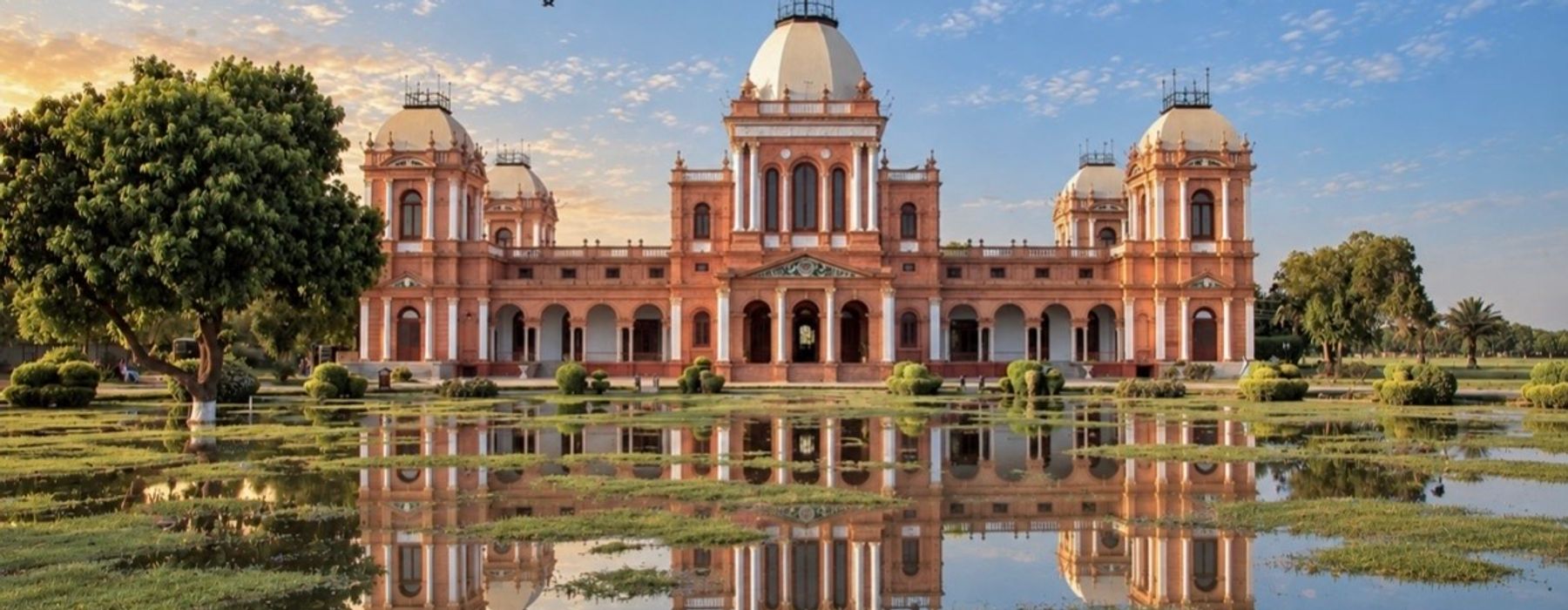
Noor Mahal is one of the most recognizable buildings in Bahawalpur.
The palace was constructed during the period of the Bahawalpur State and reflects a combination of European, Islamic and local architectural influences.
Its grand façade, domes, columns, arches and decorative interiors demonstrate the architectural ambitions of the former royal court.
Today, Noor Mahal is one of Bahawalpur's most important heritage attractions.
The palace has become an enduring symbol of the city's royal history and is frequently associated with Bahawalpur's visual identity.
DARBAR MAHAL
Darbar Mahal is another important palace associated with the Bahawalpur State.
The building was constructed as part of the royal architectural complex and features elaborate façades, domes, arches and decorative details.
Although the palace has had restricted access at different times, its architecture remains an important part of Bahawalpur's heritage.
The palace represents the scale and sophistication of the former Bahawalpur royal court.
GULZAR MAHAL
Gulzar Mahal is another historic palace associated with the Abbasi rulers.
The building reflects the architectural style of the late princely period and forms part of Bahawalpur's collection of royal monuments.
Together with Noor Mahal and Darbar Mahal, it demonstrates the variety of architectural influences present in the former state.
BAHAWALPUR CENTRAL LIBRARY
The Bahawalpur Central Library is an important historic educational institution.
The library reflects the emphasis placed on education and scholarship during the later Bahawalpur State period.
Its collection and architectural heritage contribute to the city's intellectual history.
The development of libraries, schools and colleges under the Nawabs helped establish Bahawalpur as an educational centre.
ISLAMIA UNIVERSITY BAHAWALPUR
The Islamia University of Bahawalpur is one of the major universities of southern Punjab.
The university developed from earlier educational institutions associated with the region and has grown into a large centre of higher education.
It provides education across numerous academic disciplines and attracts students from Bahawalpur as well as neighbouring districts.
The university plays an important role in research, education and cultural activity in the region.
SADIQ PUBLIC SCHOOL
Sadiq Public School is one of the best-known educational institutions associated with Bahawalpur.
The institution was established through the patronage of the Bahawalpur royal family and developed into an important residential educational institution.
Its history reflects the long-standing connection between Bahawalpur's royal heritage and education.
UCH SHARIF
Uch Sharif is one of the most historically and spiritually important places in the Bahawalpur region.
Located southwest of Bahawalpur, Uch is famous for its ancient history, Islamic scholarship and Sufi shrines.
The town contains several historic tombs associated with important Muslim saints and scholars.
Uch became an important centre of Islamic learning and Sufi traditions during the medieval period.
Its monuments form an important part of the religious heritage of southern Punjab.
SUFI HERITAGE
The Bahawalpur region contains a rich tradition of Sufi culture.
Uch Sharif in particular became associated with Sufi scholars and saints whose influence extended throughout southern Punjab.
The shrines of saints became centres of pilgrimage, spiritual teaching and community life.
Sufi traditions influenced local poetry, music, religious practice and cultural expression.
This spiritual heritage remains an important part of the region's identity.
CHOLISTAN DESERT
The Cholistan Desert is one of the defining geographical features of Bahawalpur.
Locally known as Rohi, the desert extends across a large part of southern Punjab and continues toward the Thar Desert region.
Cholistan is characterized by sand dunes, dry plains, seasonal vegetation and scattered settlements.
Despite its harsh environment, the desert has supported human communities for centuries.
Nomadic and semi-nomadic traditions, livestock herding, crafts and desert agriculture have all developed within the Cholistan environment.
ROHI
Rohi is a traditional name used for the Cholistan Desert.
The word is deeply connected with the cultural identity of the desert and appears frequently in Saraiki poetry and folk expression.
For many people of southern Punjab, Rohi represents more than a geographical landscape.
It is a cultural space associated with poetry, romance, folk traditions, migration, pastoral life and the distinctive lifestyle of desert communities.
DERAWAR FORT
Derawar Fort is perhaps the most famous historical monument associated with Bahawalpur and Cholistan.
The massive fort rises dramatically from the desert landscape and is characterized by a long line of enormous circular bastions.
Its imposing walls can be seen from a considerable distance across the surrounding desert.
The fort has been associated with different ruling dynasties over the centuries and later became closely connected with the Abbasi rulers of Bahawalpur.
Derawar served as an important defensive and administrative centre within the Cholistan region.
Today it is one of Pakistan's most recognizable desert heritage sites.
THE FORT & DESERT ROUTES
Derawar Fort was part of a broader network of forts, wells and settlements that supported movement across Cholistan.
Travel across the desert historically depended heavily on access to water.
Forts and caravan settlements therefore played an important role in protecting routes and supporting travellers.
The remains of these structures provide evidence of the historical importance of the desert as a connected cultural and commercial landscape.
CHOLISTAN'S FORTS
Derawar is the best-known fort of Cholistan, but the desert contains many other historical fortifications and settlements.
These include the remains of forts associated with old caravan routes and the changing political history of the region.
Many of these structures are now partially ruined, but they remain valuable evidence of the history of Cholistan.
Their locations also reveal how people adapted to the desert environment.
DESERT CULTURE
Cholistan has a distinctive cultural identity shaped by its environment.
Traditional desert communities have developed ways of life based on livestock, seasonal movement, agriculture where possible and access to wells and water reservoirs.
Camels have historically played an important role in transportation.
Traditional clothing, embroidery, music and storytelling are important forms of cultural expression.
The desert environment has also influenced the themes of local folk poetry.
CHOLISTANI CAMELS
Camels are closely associated with the traditional culture of Cholistan.
For centuries, camels provided transportation across the desert and supported pastoral communities.
Camel caravans once connected settlements and forts across the region.
Today, the camel remains an important cultural symbol of Cholistan even as modern roads and vehicles have transformed transportation.
CHOLISTANI CRAFTS
Cholistan is known for traditional crafts produced by local communities.
Embroidery is particularly important.
Women artisans produce colourful embroidered textiles featuring geometric patterns, mirrors, threads and decorative motifs.
Traditional rugs, woven items, leather products and other handicrafts are also produced in the region.
These crafts preserve artistic traditions that have been passed between generations.
CHOLISTANI DRESS
Traditional Cholistani clothing is known for its vibrant colours and intricate embroidery.
Women's clothing often features detailed embroidery and decorative patterns.
Men's traditional dress commonly includes loose garments suitable for the desert climate.
The colours and patterns of Cholistani textiles form an important part of the region's visual identity.
SARAiki LANGUAGE
Saraiki is one of the principal languages spoken throughout Bahawalpur and the surrounding region.
The language forms an important part of everyday life, literature, folk music and cultural expression.
Bahawalpur's location within the Saraiki cultural region has contributed to the development of distinctive local linguistic and literary traditions.
Saraiki is also deeply connected with the poetry and folk traditions of Rohi and southern Punjab.
SARAiki LITERATURE
Bahawalpur and the wider Cholistan region have contributed significantly to Saraiki literary culture.
The desert has inspired generations of poets and storytellers.
Themes of love, separation, migration, spirituality, nature, desert life and longing frequently appear in the poetry of southern Punjab.
The wider literary tradition of Khwaja Ghulam Farid is particularly important to the cultural identity of Rohi and Cholistan.
KHWAJA GHULAM FARID & ROHI
Khwaja Ghulam Farid is one of the most important Sufi poets associated with the Saraiki language.
Although his life was closely connected with Mithankot and the Rohi region, his poetry has become deeply associated with the landscape of Cholistan.
His poetry describes the desert, its people, landscapes, animals, seasons and spiritual symbolism.
The relationship between Khwaja Ghulam Farid and Rohi has made the Cholistan landscape an important literary space within Saraiki culture.
FOLK MUSIC
Bahawalpur and Cholistan have rich folk music traditions.
Local musical traditions include songs connected with love, migration, marriage, spirituality, seasonal events and everyday life.
Folk instruments and oral traditions have historically allowed stories and poetry to pass between generations.
Sufi poetry is also performed through devotional singing and musical gatherings.
FOLK STORIES & ORAL TRADITIONS
Oral storytelling remains an important element of Cholistan's cultural heritage.
Traditional stories often feature desert journeys, heroic figures, romance, spiritual themes and relationships between communities.
These stories have historically been transmitted through families, travelling performers and village gatherings.
They form part of the intangible heritage of the region.
AGRICULTURE
Although Bahawalpur is closely associated with the desert, large areas of the district are fertile agricultural land.
Irrigation has transformed parts of southern Bahawalpur into productive farming areas.
Major crops include wheat, cotton, sugarcane and other agricultural products.
Agriculture supports a large rural population and contributes significantly to the regional economy.
SUTLEJ RIVER
The Sutlej River has historically influenced settlement and agriculture in the Bahawalpur region.
Its waters have supported agricultural communities and shaped the geography of the surrounding plains.
The river is part of the wider Indus River system and has played an important role in the development of southern Punjab.
IRRIGATION
Irrigation has been fundamental to the agricultural development of Bahawalpur.
Canals and irrigation infrastructure have enabled large areas of otherwise dry land to be cultivated.
The transformation of the agricultural landscape has contributed to the growth of towns and villages throughout the district.
LIVESTOCK
Livestock farming is important in both the agricultural plains and desert regions.
Cattle, buffaloes, sheep, goats and camels are raised by communities throughout the district.
In Cholistan, livestock is particularly important because pastoral communities have historically depended on animals for food, transportation and income.
BAHAWALPUR'S ECONOMY
The economy of Bahawalpur combines agriculture, livestock, trade, services, manufacturing, education and tourism.
Agriculture remains an important economic sector.
The city also functions as a regional commercial centre serving surrounding rural communities.
Education, healthcare, government services and retail activity have become increasingly important to the modern urban economy.
TEXTILES & CRAFTS
Traditional textile work remains an important part of the cultural economy.
Embroidery, weaving and decorative textile production are practiced in Bahawalpur and Cholistan.
Modern textile and garment businesses also contribute to the region's economy.
The combination of traditional craftsmanship and modern production reflects the changing economic character of southern Punjab.
FOOD OF BAHAWALPUR
Bahawalpur's cuisine reflects the wider food traditions of southern Punjab.
Wheat, rice, lentils, vegetables, dairy products and meat form important parts of everyday meals.
Traditional breads, meat dishes, rice preparations, sweets and seasonal foods are common throughout the region.
Cholistan's pastoral culture has also influenced traditional food practices.
The city's markets contain a wide range of traditional sweets, snacks and regional dishes.
WILDLIFE
The desert and agricultural landscapes surrounding Bahawalpur support a variety of wildlife.
Cholistan contains desert-adapted animals and birds, while the agricultural and riverine areas provide different habitats.
The region is particularly significant for migratory and resident bird species.
Protected areas and conservation initiatives have become increasingly important for preserving the region's natural environment.
LAL SUHANRA NATIONAL PARK
Lal Suhanra National Park is one of the important natural areas associated with Bahawalpur.
The park contains a combination of desert, agricultural and wetland environments.
It provides habitat for wildlife and offers an important recreational and conservation space near Bahawalpur.
The park demonstrates the ecological diversity that exists around the transition between the desert and irrigated agricultural landscape.
CLIMATE
Bahawalpur has a hot and generally dry climate.
Summers can be extremely hot, particularly in areas closer to the Cholistan Desert.
Winters are comparatively mild and can be pleasant.
The climate has strongly influenced local architecture, clothing, agriculture and traditional ways of life.
DESERT & AGRICULTURAL LANDSCAPE
One of Bahawalpur's most distinctive characteristics is the contrast between its desert and agricultural landscapes.
Within the same district, visitors can encounter irrigated fields, orchards, riverine areas, dry plains and vast sand dunes.
This environmental diversity has shaped different communities and economic activities.
It is also one of the reasons Bahawalpur has such a distinctive cultural identity.
BAHAWALPUR'S ARCHITECTURE
The architectural heritage of Bahawalpur combines Islamic, Indo-Islamic, Mughal, European and local influences.
Royal palaces contain European-inspired façades and grand interiors.
Historic mosques feature domes, arches and decorative tilework.
Traditional houses and bazaars preserve local building techniques.
Together these structures create an architectural landscape unlike many other cities of Pakistan.
ABBASI MOSQUE
The Abbasi Mosque is one of the best-known religious buildings associated with the Bahawalpur royal heritage.
Located near the entrance to Derawar Fort, the mosque was built by the Abbasi rulers.
Its white exterior, domes and elegant proportions create a striking contrast with the surrounding desert landscape.
The mosque remains an important example of the religious architecture associated with the Bahawalpur State.
SADIQ GARH PALACE
Sadiq Garh Palace is another important royal monument associated with the Bahawalpur State.
The large palace complex was constructed during the reign of the Abbasi rulers and contains extensive grounds, gardens and architectural features.
It reflects the scale and grandeur of the former royal court.
Although access and preservation conditions have varied over time, the palace remains an important part of Bahawalpur's architectural heritage.
HISTORIC BAZAARS
Bahawalpur's traditional bazaars preserve elements of the city's commercial heritage.
Shops sell textiles, handicrafts, clothing, jewellery, food and household goods.
The bazaars also provide a place where rural and urban communities interact.
Traditional markets remain an important part of everyday life in the city.
RELIGIOUS HERITAGE
Bahawalpur and its surrounding region contain mosques, shrines, tombs and historic religious institutions.
Uch Sharif is particularly important for Sufi heritage.
The region's religious monuments reflect centuries of Islamic scholarship and spiritual traditions.
These sites continue to attract pilgrims and visitors.
URS & SHRINES
Annual urs celebrations at major shrines bring together devotees from different parts of southern Punjab.
These gatherings may include prayers, devotional music, poetry and traditional ceremonies.
The shrine culture of Bahawalpur demonstrates the continuing relationship between religious heritage and everyday community life.
BAHAWALPUR'S PEOPLE
Bahawalpur's population includes urban residents, agricultural communities and desert populations.
The city attracts students, professionals, traders, government employees and workers from surrounding districts.
The wider district contains numerous rural communities whose livelihoods are connected with agriculture and livestock.
The cultural diversity of these communities contributes to the character of the region.
MODERN BAHAWALPUR
Modern Bahawalpur has developed significantly beyond its historical role as a princely capital.
The city now functions as an administrative, educational, healthcare and commercial centre.
Universities, hospitals, shopping areas, government offices, residential developments and modern roads have transformed the urban landscape.
At the same time, the city's royal buildings, historic bazaars and cultural institutions continue to preserve its historical character.
TOURISM
Bahawalpur has significant cultural and heritage tourism potential.
Major attractions include Noor Mahal, Derawar Fort, the Abbasi Mosque, Sadiq Garh Palace, Uch Sharif, Lal Suhanra National Park and the historic royal architecture of the city.
Cholistan also attracts visitors interested in desert landscapes, traditional communities, photography, camping and heritage exploration.
The combination of desert scenery, architecture and Sufi heritage gives Bahawalpur a distinctive tourism identity.
CHOLISTAN DESERT JEEP RALLY
The Cholistan Desert Jeep Rally is one of the best-known modern events associated with the region.
The event brings motorsport, tourism and desert culture together and attracts participants and visitors from across Pakistan.
The rally has helped introduce wider audiences to the landscape of Cholistan and has become an important annual event for the region.
It also provides an opportunity to showcase local crafts, food and cultural traditions.
BAHAWALPUR & SOUTHERN PUNJAB
Bahawalpur is one of the principal historical centres of southern Punjab.
Its history connects the agricultural plains of the Sutlej region with the desert communities of Cholistan.
The former Bahawalpur State also played an important role in the political and administrative history of the region.
Today, Bahawalpur remains an important centre for education, agriculture, commerce and cultural activity.
BAHAWALPUR & SARAIKISTAN
For Saraikistan, Bahawalpur represents one of the most distinctive cultural landscapes of the Saraiki region.
The city's royal history, the desert traditions of Rohi, the Sufi heritage of Uch Sharif, the poetry associated with Khwaja Ghulam Farid, traditional crafts and the Saraiki language all contribute to its cultural significance.
Bahawalpur demonstrates how different environments can exist within one cultural region.
The irrigated agricultural plains and the Cholistan Desert have produced different lifestyles, yet they remain connected through language, history and cultural traditions.
LIVING HERITAGE
Bahawalpur's heritage is not limited to palaces and forts.
It lives in the Saraiki language spoken in homes and markets.
It lives in the embroidery produced by Cholistani artisans.
It lives in the poetry inspired by Rohi.
It lives in the music performed at gatherings and shrines.
It lives in the traditions of desert communities.
It lives in the agricultural fields surrounding the city.
It lives in the food, crafts, architecture and stories passed from one generation to another.
The city's historic buildings provide a physical record of its past, while its people continue to carry that heritage into the present.
BAHAWALPUR — THE ROYAL GATEWAY TO ROHI
Bahawalpur is a city where royal history meets desert culture.
Its palaces preserve the memory of the Abbasi rulers.
Derawar Fort rises from the Cholistan landscape as a symbol of the region's fortified past.
Uch Sharif preserves centuries of Sufi and scholarly traditions.
The Saraiki language connects the city with the wider cultural landscape of southern Punjab.
Traditional crafts preserve the artistic knowledge of desert communities.
Agriculture connects the city with the fertile plains of the Sutlej region.
Together, these elements make Bahawalpur one of the most distinctive cultural centres of Saraikistan.
Its story is a story of rulers and scholars, deserts and rivers, palaces and villages, poets and artisans, agriculture and trade.
Bahawalpur continues to carry the memory of the former princely state while evolving as a modern city of southern Punjab.
For Saraikistan, Bahawalpur is not simply a historic city.
It is a gateway to Rohi, a centre of Saraiki heritage, a home of royal architecture, a landscape of Sufi traditions and one of the places where the diverse cultural history of southern Punjab remains visibly alive.