
Culture
Crafts of South Punjab: Blue Pottery, Embroidery and Taadi
9/29/2026
Biography
Crafts of South Punjab: Blue Pottery, Embroidery and Taadi
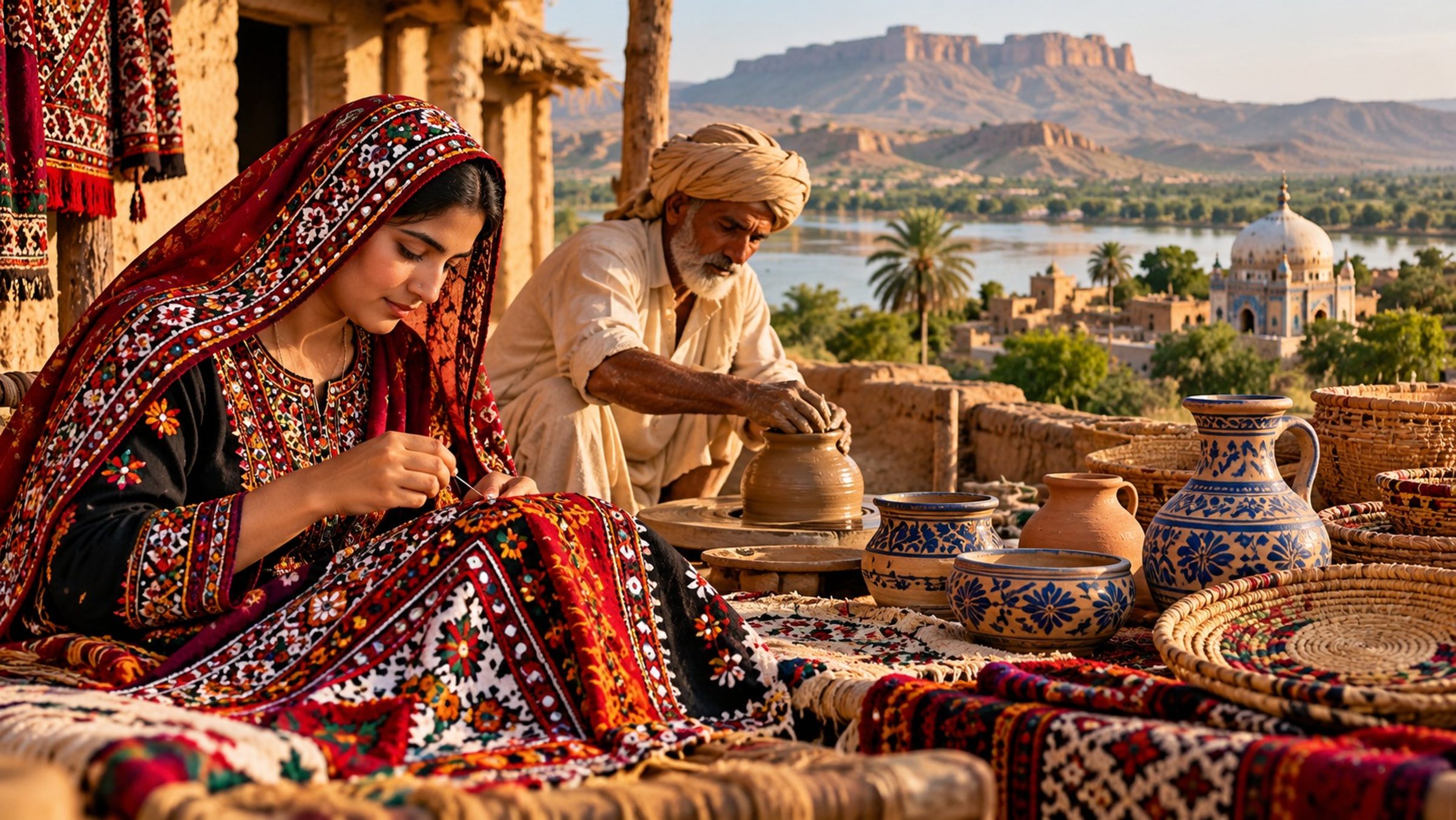
Traditional crafts are easiest to understand through the places and people connected to them. Published references identify Multan for blue pottery and camel-skin lamps, and document distinct embroidery and date-palm-leaf work in South Punjab. These examples show the range of craft knowledge associated with the region, while each has its own materials and methods.
This article draws on Pakistan’s National Register of Intangible Cultural Heritage and SMEDA’s SME Investment and Business Guide: South Punjab (2021–22). It summarizes those published references; it is not based on new interviews with artisans.
Multan’s blue pottery and tile work
Blue pottery is one of Multan’s best-known crafts. Pakistan’s National Register describes it as part of the city’s traditional craftsmanship and documents both pottery and painted tiles.
The register describes a process that begins with preparing clay. The clay is softened, shaped or cut, and carved before designs are applied. It describes cobalt-based pigment producing blue and copper-based pigment producing turquoise after firing. The finished work may include individual pots or joined tile panels for larger designs.
These steps involve preparing the material, shaping or carving it, applying the design, glazing the piece, and firing it carefully. The register’s description gives readers a clearer picture of the skill involved than a general statement that pottery is handmade.
Camel-skin lamps
The National Register also documents camel-skin lamps as a craft practiced in Multan. Its description says the skin is cleaned and thinned so light can pass through it, fixed over a clay base, and left to dry. The dried skin is then shaped and painted.
The painted surface can carry small, detailed designs. This example connects material knowledge with the practical purpose of the finished object: the prepared skin becomes a translucent cover for a lamp.
Embroidery and textile work
SMEDA’s 2021–22 South Punjab guide names several distinct textile practices rather than treating regional embroidery as one uniform style. It associates cross-stitch garments, bedsheets, and curtains with Multan; tar kashi with Multan, Kahror Pacca, and Dera Ghazi Khan; and kucha tanka, Balochi work, and mirror work with Dera Ghazi Khan.
The guide also lists kan dani, mukesh, gotta, and chunri among Bahawalpur’s specialties. These examples help distinguish techniques and locations. The guide does not provide enough detail to explain the stitches or designs, so those would be good subjects for interviews with local makers.
Taadi and date-palm leaves
SMEDA’s guide describes taadi as a Saraiki name for prayer mats made from date-palm leaves. It also mentions chhabi: multicoloured trays made from date-palm leaves and decorated with beads.
These examples connect craft to a specific material. A firsthand account from a maker could explain how the leaves are prepared, how they are woven, how long a mat or tray takes, and how designs vary from one place or family to another. Those details are not supplied in the guide, so they should be added only after they are verified locally.
Keeping the record specific
A regional craft archive should record who makes an object, where it is made, what materials and tools are used, and how the technique is learned. Published guides can help identify crafts and locations, but they cannot replace conversations with the people who practice them.
Saraikistan welcomes information from artisans and researchers. If you make or document one of these crafts, contact us with the maker’s preferred name, location, process details, and photographs you have permission to share. We aim to identify contributed information and check details before adding them to the archive.
Sources
- Government of Pakistan, National Register of Intangible Cultural Heritage, entries “Blue Pottery and Tiles” and “Camel Skin Lamps” (printed pages 112–113): https://heritage.pakistan.gov.pk/SiteImage/Misc/files/ICH%20Pakistan%20Low.pdf
- SMEDA, SME Investment and Business Guide: South Punjab (2021–22), section 6.4, “Handicrafts” (printed page 20): https://smeda.org/index.php?Itemid=1027&download=1898%3Asme-investment-business-guide-south-punjab-2021-22&id=188%3Asector-studies-reports&option=com_phocadownload&view=category