Stories
The Story of Saraiki Language
9/21/2026
Biography
Saraiki Beyond Its Traditional Heartland
The story of Saraiki did not remain confined to the towns and villages where the language developed.
Migration gradually carried Saraiki-speaking families to cities across Pakistan and to communities abroad.
Large urban centres became home to people from the Saraiki-speaking region.
In these new environments, language became an important connection to family, hometowns and cultural memory.
A person living far from the Indus valley could still speak Saraiki at home, listen to Saraiki music, read poetry and maintain connections with relatives and communities in the region.
The language therefore travelled with its speakers.
Wherever its people went, Saraiki carried a piece of their homeland with them.
Saraiki in the Digital Age
The arrival of the internet created a completely new environment for the language.
Websites, social media, YouTube, podcasts and digital publishing have opened new opportunities for Saraiki creators.
A poem that once depended on a local gathering can now reach listeners around the world.
A folk song recorded in a small town can be viewed by an international audience.
Young writers can publish their work without relying entirely on traditional publishing institutions.
Digital platforms have also made it easier for younger generations to discover older poetry and music.
This is particularly important for languages whose cultural traditions have historically depended heavily on oral transmission.
The digital world has given Saraiki a new space in which its old traditions can continue to evolve.
The Language and the 2023 Census
Pakistan's 2023 Population and Housing Census recorded 28,849,579 people as Saraiki speakers by mother tongue.
This figure provides an important statistical picture of the language's presence in contemporary Pakistan.
However, census figures should be understood within the limitations of self-reported language data and the way categories are defined.
Language identity can also overlap with regional, family and cultural identities.
For that reason, the cultural presence of Saraiki cannot be understood through a single number alone.
Behind every statistic are communities, families and individuals who continue to use the language in everyday life.
Regional Varieties of Saraiki
Saraiki is not completely uniform across its entire geographical area.
Like other major languages, it contains regional varieties shaped by geography, history and contact with neighbouring languages.
Differences can be heard in pronunciation, vocabulary and certain grammatical features.
Speech patterns around Multan may differ from those found farther south, west or east.
Communities near Punjabi-speaking, Sindhi-speaking, Balochi-speaking and Pashto-speaking areas have also experienced different forms of linguistic contact.
These differences do not necessarily prevent mutual understanding.
Instead, they demonstrate the natural diversity that exists within a living language.
Variation is not a weakness of a language; it is evidence of its history and continued use.
Saraiki and Its Neighbouring Languages
Saraiki exists within a multilingual environment.
Its speakers have historically interacted with communities speaking Punjabi, Sindhi, Urdu, Balochi, Pashto and other languages.
Trade, migration, education, administration and marriage have created centuries of linguistic exchange.
As a result, Saraiki shares features and vocabulary with neighbouring languages while maintaining its own distinctive characteristics.
This makes the language part of a much larger linguistic landscape.
Languages do not develop in isolation.
They borrow, adapt and change as communities interact.
Saraiki's history is therefore also a history of contact.
Literature, Music and Cultural Memory
Saraiki culture cannot be separated from its literature and music.
Poetry remains one of the most powerful forms through which the language expresses emotion and memory.
Folk music carries stories of love, separation, longing, devotion and everyday life.
Sufi poetry continues to be performed by singers and musicians.
Traditional forms exist alongside modern arrangements and contemporary musical styles.
This combination of old and new has allowed Saraiki music to remain relevant to younger audiences.
The same can be seen in literature.
Modern writers continue to engage with the literary traditions inherited from earlier generations while exploring new subjects.
Tradition survives not by remaining frozen, but by being carried into new generations.
Preserving the Language
Like many regional languages around the world, Saraiki faces challenges in the modern age.
Urbanization, migration, changing education patterns and the dominance of larger languages can influence how younger generations use their mother tongue.
Preserving a language therefore requires more than simply remembering its existence.
It requires active use.
Children need opportunities to hear and speak it.
Writers need spaces to publish.
Musicians need audiences.
Researchers need resources.
Digital creators need platforms.
And cultural institutions need to document historical material.
The preservation of Saraiki depends on the combined efforts of families, communities, writers, artists, educators, researchers and digital creators.
Saraiki in Education and Research
Academic research has increasingly examined Saraiki from linguistic, literary and cultural perspectives.
Researchers study its grammar, vocabulary, regional varieties, oral traditions, poetry and historical development.
Universities and cultural institutions can play an important role in documenting manuscripts, recordings, dictionaries and other forms of cultural heritage.
Digital archives can also help preserve materials that might otherwise become difficult to access.
The development of educational resources is equally important.
Books, dictionaries, language courses and digital learning materials can make Saraiki more accessible to younger generations and to people who want to study the language from outside the region.
A language becomes stronger when its knowledge can be passed from one generation to the next.
The Future of Saraiki
The future of Saraiki will be shaped by its speakers.
Technology will play an important role, but technology alone cannot preserve a language.
A language remains alive when people use it.
When parents speak it with their children.
When grandparents pass down stories.
When poets write new verses.
When musicians create new songs.
When teachers teach it.
When researchers document it.
When filmmakers and creators use it.
And when young people feel comfortable carrying it into the future.
The challenge is therefore not simply to preserve Saraiki as an artifact of the past.
The greater challenge is to ensure that it remains a living language.
From the Indus to the Digital World
The story of Saraiki stretches across an enormous span of time.
Its geographical homeland has been shaped by the Indus River, deserts, mountains, agriculture, migration and trade.
Its linguistic development belongs to the long history of the Indo-Aryan languages of South Asia.
Its cultural identity was strengthened by centuries of poetry, Sufi traditions, folk literature and oral memory.
Its literary heritage reached extraordinary expression through poets such as Khwaja Ghulam Farid.
Its modern identity developed during a period of profound social, political and cultural change.
And today, Saraiki has entered a new era.
It exists in books and newspapers.
In songs and television.
In universities and cultural organizations.
In homes and communities.
And increasingly, across websites, social media and digital platforms.
The medium has changed.
The people have changed.
The world around the language has changed.
But the language continues.
A Living Heritage
Saraiki is not simply a language of the past.
It belongs to the present.
And it belongs to the future.
Its history cannot be reduced to a single date or a single origin story.
Its roots lie in a region whose civilization is thousands of years old.
Its linguistic development unfolded over centuries.
Its literary identity grew through regional speech traditions, Sufi culture, poetry and oral memory.
Its modern name emerged much later.
And its future is being shaped today by millions of speakers and creators.
From the ancient Indus landscape to the modern digital world, Saraiki continues to carry something forward.
Memory.
Poetry.
Place.
Identity.
Belonging.
The story of Saraiki is still being written.
In homes.
In villages.
In cities.
In classrooms.
In books.
In songs.
At shrines.
On stages.
On radio.
On television.
And across the digital world.
Saraiki survives because people speak it, sing it, write it and remember through it.
It is not only the language of a region.
It is one of the ways that region remembers who it is.
Image Credits+
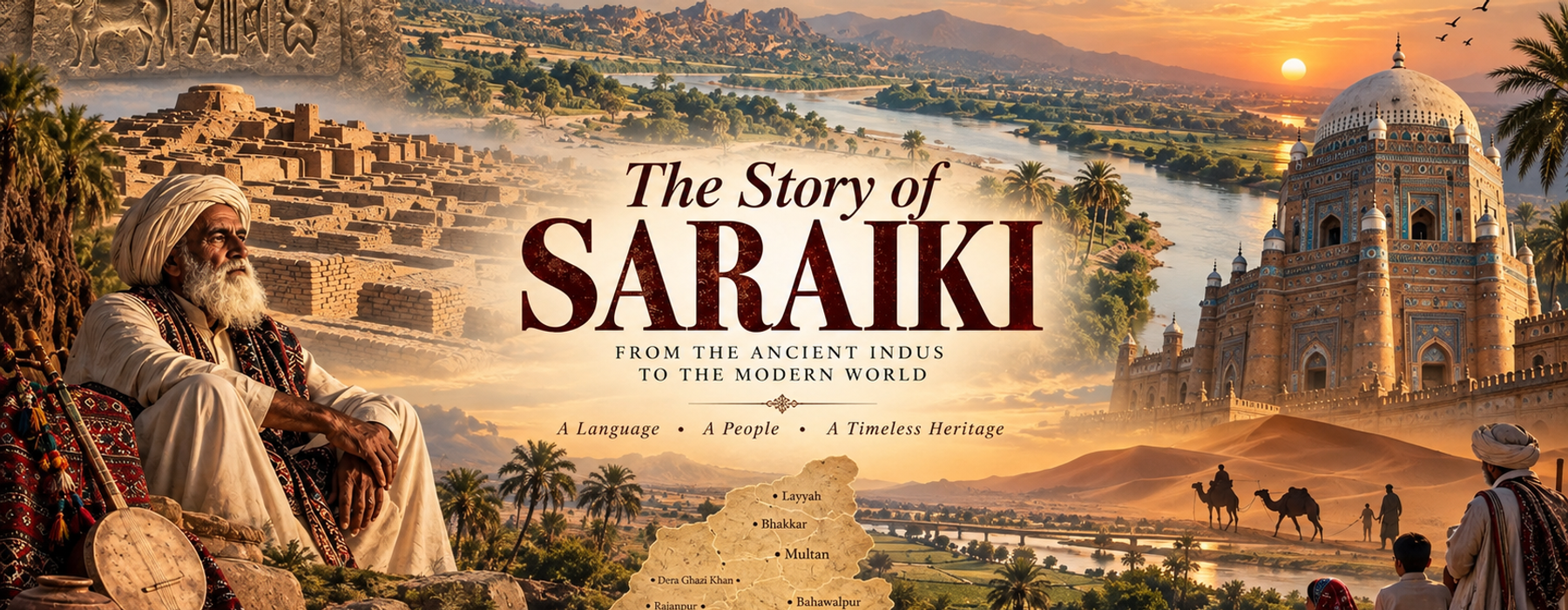
AI-generated cover artwork created for Saraikistan.